Glycolic vs Lactic vs Mandelic Acid: How They Differ
Glycolic, lactic and mandelic acid are all alpha hydroxy acids, and the main difference is molecule size. Glycolic is the smallest and works fastest, lactic is gentler and more hydrating, and mandelic is the largest and slowest, which suits sensitive skin.
Key takeaways
- Glycolic acid is the strongest. Its small molecule gets in quickly, so irritation risk is higher.
- Lactic acid is the middle ground. It exfoliates and also draws in moisture.
- Mandelic acid is the slowest. Its larger molecule makes it a common pick for sensitive skin.
- Percentage and pH matter. The same acid behaves differently in different formulas.
- Use SPF every morning. All three can increase sun sensitivity.
What is the difference between glycolic, lactic and mandelic acid?
The difference is mostly size and speed. Glycolic acid has the smallest molecule and penetrates fastest, lactic acid is larger, and mandelic acid is the largest and moves in slowest.
Smaller usually means faster and more potent, and also more likely to sting or dry skin. Larger usually means slower and gentler.
| Acid | Feel | Who might start here |
|---|---|---|
| Glycolic | Fast, most potent | Tolerant, oilier or dull skin |
| Lactic | Moderate, more hydrating | Dry or normal skin |
| Mandelic | Slow, gentlest | Sensitive or reactive skin |
Which AHA is best for sensitive skin?
Mandelic acid is the usual first choice for sensitive skin because it is absorbed slowly. Lactic acid is the next step, since it exfoliates while also acting as a humectant.
Glycolic acid is better saved for skin that is already comfortable with acids. Start with a low strength and use it a couple of evenings a week.
Our guides to mandelic acid, lactic acid and glycolic acid go into each acid in more detail.
What strength and pH are AHAs used at?
Strength and pH change how an AHA behaves. In their safety review, the Cosmetic Ingredient Review panel concluded that glycolic and lactic acid are safe in consumer products up to 10% at a pH of 3.5 or higher, when formulated to avoid increased sun sensitivity or used with sun protection directions.
A lower pH makes an AHA stronger, so a 5% product can feel harsher than a 10% one. Check the product's directions rather than relying on the percentage alone.
Use SPF 30+ every morning while you use any of them.
How do you spot these acids on a label?
Look for Glycolic Acid, Lactic Acid or Mandelic Acid in the ingredient list, and check for a percentage. Many exfoliants blend several acids.
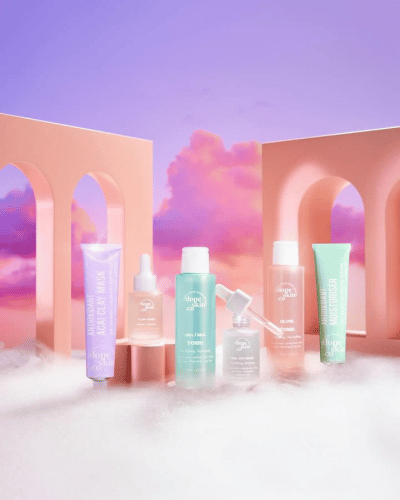
Our AHA/BHA Exfoliating Tonic, Resurfacing Serum and Exfoliating Cleanser list Lactic Acid and Glycolic Acid alongside Salicylic Acid, Gluconolactone, Malic Acid and Tartaric Acid. The product pages describe the tonic and cleanser as 8% AHAs and the serum as 10% AHAs.
The Glow Tonic and Glow Serum list Lactic Acid too, with Gluconolactone.
To see the exfoliating range, visit the AHA/BHA Exfoliating Tonic or take the skincare quiz.
Who should skip AHAs or go slow?
Skip them if you are pregnant or breastfeeding unless your doctor says otherwise. Our AHA/BHA product pages say the same.
Go slow if your skin is irritated, sunburnt or very dry. Do not use acids on the same night as a retinoid, and patch test before the first full application.
FAQ
Which is stronger, glycolic acid or lactic acid?
Glycolic acid, because its smaller molecule penetrates faster. Lactic acid is generally milder.
Can I use glycolic and lactic acid together?
Many products blend them. Layering separate products raises irritation risk, so build up slowly.
Does mandelic acid work as well as glycolic acid?
It works more slowly and gently, so results can be slower. The trade-off is usually less irritation.
Related ingredients
Sources
- Applications of hydroxy acids: classification, mechanisms, and photoactivity, Kornhauser et al., Clin Cosmet Investig Dermatol 2010
- Cosmetic Ingredient Review, Final amended report on the safety assessment of glycolic acid, lactic acid and their salts and esters (alpha hydroxy acids), Int J Toxicol 1998